

Moving After Divorce: How a New Home Can Help You Build a Fresh Start (Guest Blogger Michelle Casey)
Moving after divorce gives people who have recently ended a marriage an opportunity to create a home that supports stability, comfort, and the next chapter of everyday life.
Yes, moving boxes may multiply when nobody is looking, and somehow the tape dispenser will disappear precisely when you need it. But a new address can also offer something surprisingly valuable: a chance to decide what you want your surroundings—and your routines—to look like now.
A home cannot solve everything that comes with divorce. It can, however, make daily life feel more manageable. By choosing your space deliberately, establishing familiar routines, and surrounding yourself with things that make life easier, relocation can become less about what you left and more about what you're building.
The Short Version
A post-divorce move can support a fresh start when the new home provides three things:
predictability, practicality, and room for personal choice.
Keep familiar routines where they help. Organize the essentials before worrying about decorating every room. Make the new place comfortable enough that coming home feels like a relief rather than another project.
And give yourself permission to make a few changes simply because you like them. You are now the entire decorating committee.
Start With Stability, Then Add Personality
After a major life change, ordinary routines can be surprisingly reassuring. Knowing where the coffee mugs live, what happens on Tuesday evenings, or which chair has officially become the reading chair creates small points of predictability.
That matters even more when children are moving with you. Familiar belongings, dependable schedules, and consistent household expectations can make a different house feel more recognizable. If a move will affect an existing custody or parenting arrangement, however, address the legal questions before treating relocation as purely a housing decision. Relocation requirements vary by state, particularly when children are involved.
Once the practical foundation is there, add some personality. Paint a wall. Rearrange the furniture. Finally admit that you never actually liked that enormous decorative vase. Small choices can reinforce the pleasant realization that this space belongs to the life you're creating now.
A Simple New-Home Reset
Instead of attempting a television-worthy transformation in one heroic weekend, build your home in stages.
1. Set up the essentials first. Get the bed, bathroom, kitchen basics, medications, chargers, work supplies, and children's necessities functioning.
2. Create one genuinely comfortable area. A finished bedroom, reading corner, or living room gives you somewhere to retreat when the remaining boxes start judging you.
3. Rebuild useful routines. Decide when groceries happen, where keys go, how mornings work, and when household tasks get done.
4. Add familiar objects. Photos, books, blankets, artwork, and favorite kitchen items can make unfamiliar surroundings feel grounded.
5. Choose one intentional change. Try a new hobby corner, different décor, a small garden, or another feature that belongs specifically to this chapter.
The result isn't simply an unpacked house. It's an environment with fewer daily friction points and more cues that life has a workable rhythm again.
Keep the Paperwork From Becoming a Second Move
Divorce and relocation can produce an impressive supporting cast of documents. Custody or parenting agreements, financial records, insurance information, housing documents, and moving paperwork are easier to manage when they're kept in one secure, organized system rather than scattered through email accounts, drawers, and mysterious folders labeled “IMPORTANT.”
Create clearly named digital folders, keep appropriate backups, and protect sensitive records with suitable account and device security. Saving documents as PDFs can also help preserve their formatting and make files easier to view consistently across devices. When paperwork arrives in another format, you can use a free online converter; Adobe explains the process in this guide. A little organization now can mean considerably less frantic searching later.
What Can a New Home Help You Change?
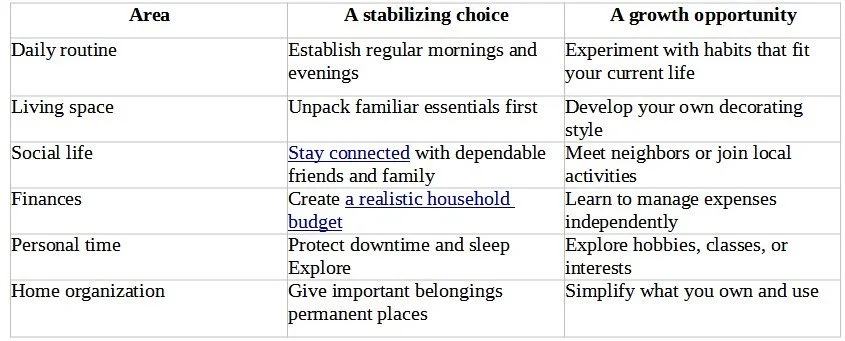
Personal growth doesn't have to mean reinventing yourself by next Thursday. Often, it looks much less dramatic: making decisions independently, becoming more confident with money, cooking something new, meeting people, or discovering that you are perfectly capable of assembling a bookshelf—as long as nobody asks why three screws are left over.
Give Yourself a Few Easy Wins
A new environment naturally disrupts old patterns, which means it can also make room for better ones. Consider using the move to:
● establish a morning or evening routine that suits you now;
● explore your neighborhood and identify a few dependable local spots;
● reconnect with friends or relatives you want in your everyday life;
● create a dedicated space for exercise, reading, crafting, music, or another interest;
● remove belongings that create clutter without providing much usefulness or happiness.
None of these changes needs to be monumental. The point is to create evidence, one small decision at a time, that your new life is becoming more functional and more distinctly yours.
One Resource Worth Bookmarking
If children are part of your post-divorce move, the American Bar Association's Family Law Resources page is a useful starting point for general information about divorce, parent-child relationships, financial matters, and other family-law topics. You can explore the ABA Family Law Resources and use them to identify issues worth discussing with a qualified attorney in your state.
That distinction matters because relocation rules aren't uniform. A move that affects parenting time or a child's residence may involve notice, consent, custody-plan changes, or court involvement depending on the circumstances and jurisdiction.
FAQ: Moving Forward Without Rushing It
Should I completely redecorate after divorce?
Only if you want to. Keeping familiar furniture and belongings can provide continuity, while changing selected parts of the space can help the new home feel like yours. There is no requirement to celebrate independence by immediately purchasing seventeen throw pillows.
How can I make a new home easier for children?
Prioritize familiar belongings and predictable routines, and listen to children's concerns about changes affecting them. Consistency and communication between co-parents can also help children navigate post-divorce life.
What if my new home doesn't feel like home immediately?
Give it time. Homes develop through routines, memories, familiarity, and ordinary daily use—not simply through unpacking. Concentrate first on making the space functional and comfortable.
Can moving really encourage personal growth?
It can create opportunities for it. Managing a household differently, establishing new routines, exploring a community, making independent decisions, and trying new activities can all help you discover what works for your life after divorce.
Relocating after divorce doesn't erase the difficult parts of what came before, but it can give the next chapter a physical starting point. Build stability first, introduce change at a pace that feels manageable, and allow your home to evolve alongside you. Eventually, the boxes disappear, routines become ordinary, and the unfamiliar address starts feeling like yours. And that is a pretty good beginning.
Today’s guest blogger is Michelle Casey who is the founder of DIY PRO, a website that provides tips and advice for home improvement projects. Michelle created DIY PRO in response to the COVID-19 pandemic, which forced her to learn home repair projects in order to save money. She realized that flexibility in terms of living should be a must, and decided to share her knowledge with others through DIY PRO. Michelle is an avid crafter, and she enjoys using her skills to help others save money and have fun.