

Mastering Life’s Big Changes with Practical Steps and Support
For new parents, first-time homebuyers, mid-career professionals in transition, and adults supporting a sick family member, major life transitions can scramble both emotions and logistics at the same time. The emotional challenges of change show up as worry, grief, irritability, or numbness, especially when stress from unexpected events steals a sense of control. Meanwhile, the practical difficulties during life shifts, new routines, new roles, and new decisions, make even simple days feel harder than they should. The key is recognizing that adaptation to new circumstances is a skill that can be built under pressure.
Use 6 Practical Playbooks for Common Life Transitions
Big changes can make you feel scattered. That’s totally normal when your routines and identity are shifting at once. The fastest way back to steadiness is a simple playbook: a short checklist, a small daily action, and a plan for your stress response.
Build a 72-hour “stabilize first” plan: In the first three days, focus on what reduces chaos quickly: sleep, food, movement, and one admin task per day. Write down your “minimum viable routine” (wake time, one meal you can always make, 10 minutes of tidying) so you don’t rely on motivation. This works because it restores predictability. Your brain reads that as safety when everything feels off-balance.
Moving house: run a two-list checklist (Must-Do vs. Nice-to-Do): Create one page with only deadline-driven items: changing your address, transferring utilities, moving-day access, key handoff, and a “first-night box” with meds, chargers, toiletries, and bedding. Keep a second list for upgrades and organizing so it doesn’t hijack your energy during the move. Add two calendar blocks right away: one 45-minute “paperwork sprint” and one 60-minute “purge by category” (clothes, books, kitchen).
Career change: choose a target and test it in 2 weeks: Instead of “find a new job,” pick one direction (role + industry + level) and run two small tests: one informational chat and one work sample (a mini project, mock presentation, or portfolio piece). Use a tight script: “I’m exploring X. What does a normal week look like, and what would you learn first?” This builds clarity and momentum without committing your whole identity to a single leap.
Coping with illness: plan for bad days, not just best days: Make a “flare-day protocol” with three tiers: green (normal), yellow (reduced), and red (bare minimum). Pre-decide what gets paused, who you’ll notify, and what support you’ll accept (meals, rides, childcare, check-ins). Stress drops when decisions are made ahead of time. That’s why checklists help so much. Resources like a turning 18 checklist show how “critical steps” get simpler when they’re written once and reused.
New parenthood: define what “good enough” looks like this week: Pick one priority per category: baby care, home basics, and connection (for example, a feeding plan, one load of laundry per day, and a 10-minute check-in with a partner or friend). Create a shift handoff note (sleep, meds, supplies to restock) so you’re not re-explaining everything while exhausted. This works because it lowers the cognitive load when your days are unpredictable.
Home buying or starting a business: separate decisions into “today,” “this month,” and “later”: For home buying, “today” might mean setting a budget range and listing your must-haves. “This month” is pre-approval and neighborhood research. “Later” is paint colors and furniture. For a business, “today” is the offer and first customer conversation. “This month” is pricing and a simple tracking system. “Later” is branding and scaling. When overwhelm hits, use a 10-minute stress reset: name your next three actions, take five slow breaths, and then do the smallest one.Get Job-Change Ready: Refresh Your Resume and Documents First
Once you’ve picked the right playbook for your transition, a job change gets easier when you start with one low-stress win: get your paperwork ready. If you’re looking for a new position, update your resume before you send out a single application. Aim for a “current snapshot” that reflects your latest skills, experience, and achievements, so you’re not scrambling to remember details later or rushing edits when an opportunity comes up.
Also pay attention to the file formats you’re working with. If your resume (or other application documents) is locked in a PDF and you need to make major text or formatting changes, you’ll quickly run into the limits of what’s easy to edit in a PDF, which can turn simple updates into a frustrating, time-consuming process. In that case, using a tool like the best PDF to DOCX converter can help: upload the PDF, convert it to a Word document, make your edits in Word, and then save it back as a PDF when you’re finished.
Accept → Plan → Act → Adjust (Repeat Weekly)
Big life shifts feel chaotic because so many decisions compete at once. This workflow gives you a simple sequence to follow when emotions, logistics, and new routines collide, so you can keep moving without forcing perfection. Run it weekly or whenever a surprise hits, and you will always know what to do next.
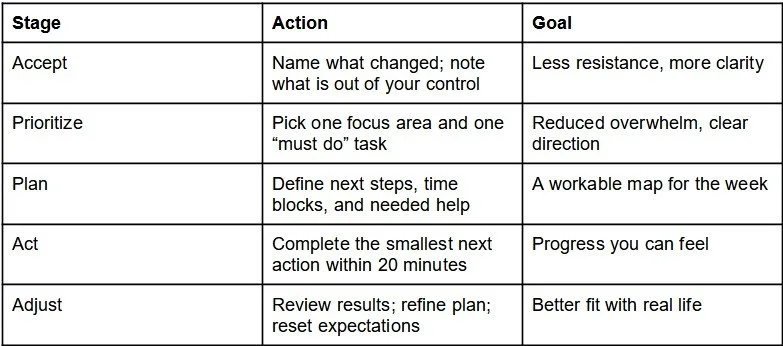
Acceptance keeps you from fighting reality, and prioritizing stops you from trying to solve everything at once. Planning turns uncertainty into manageable steps, action builds confidence through motion, and adjustment keeps the system honest when conditions change.
Common Questions About Handling Major Life Changes
Q: What do I do first when plans fall apart overnight?
A: Start by naming what changed and what you cannot control, in plain words. Then choose one urgent need for the next 24 hours, like food, sleep, childcare, or a critical call. Take one tiny action within 20 minutes to regain traction.
Q: How can I handle uncertainty without spiraling into worst-case thinking?
A: Write down three facts you know today and one decision you can delay safely. Set a short “worry window” (10 minutes), then shift to a grounding task like a walk, shower, or simple meal. Uncertainty shrinks when your body feels steadier.
Q: Why does grief show up even when the change is positive?
A: Big transitions often include loss of identity, routine, or expectations, even when you wanted the outcome. Let both feelings exist by journaling for five minutes or saying, “I can be grateful and sad.” If emotions feel stuck, talk with a counselor or grief group.
Q: How do I build emotional resilience when I feel fragile?
A: Keep promises small: consistent sleep, regular meals, and one daily reset like breath counting for two minutes. Track one win each day, even if it is just “I showed up.” Confidence grows from repeated proof that you can cope.
Q: When should I ask for help, and who should I contact?
A: Ask sooner than you think, especially if you are not functioning at work, home, or in relationships. Start with one trusted friend, your primary care doctor, a therapist, or a community support line. Be specific: request a ride, a meal, or help making calls.
Take One Practical Step to Steady Your Life Transition
When life shifts suddenly, it’s easy to feel stuck between what was and what’s next, with uncertainty doing most of the talking. A steadier way through is embracing change proactively, pairing honest self-checks, flexible planning, and support so the transition feels navigable instead of chaotic. Over time, that approach builds confidence in transitions and creates empowerment during change, even when the future is still taking shape. Confidence comes from choosing the next right step, not predicting the whole path.
Today’s guest blogger is Michelle Casey who is the founder of DIY PRO, a website that provides tips and advice for home improvement projects. Michelle created DIY PRO in response to the COVID-19 pandemic, which forced her to learn home repair projects in order to save money. She realized that flexibility in terms of living should be a must, and decided to share her knowledge with others through DIY PRO. Michelle is an avid crafter, and she enjoys using her skills to help others save money and have fun.